
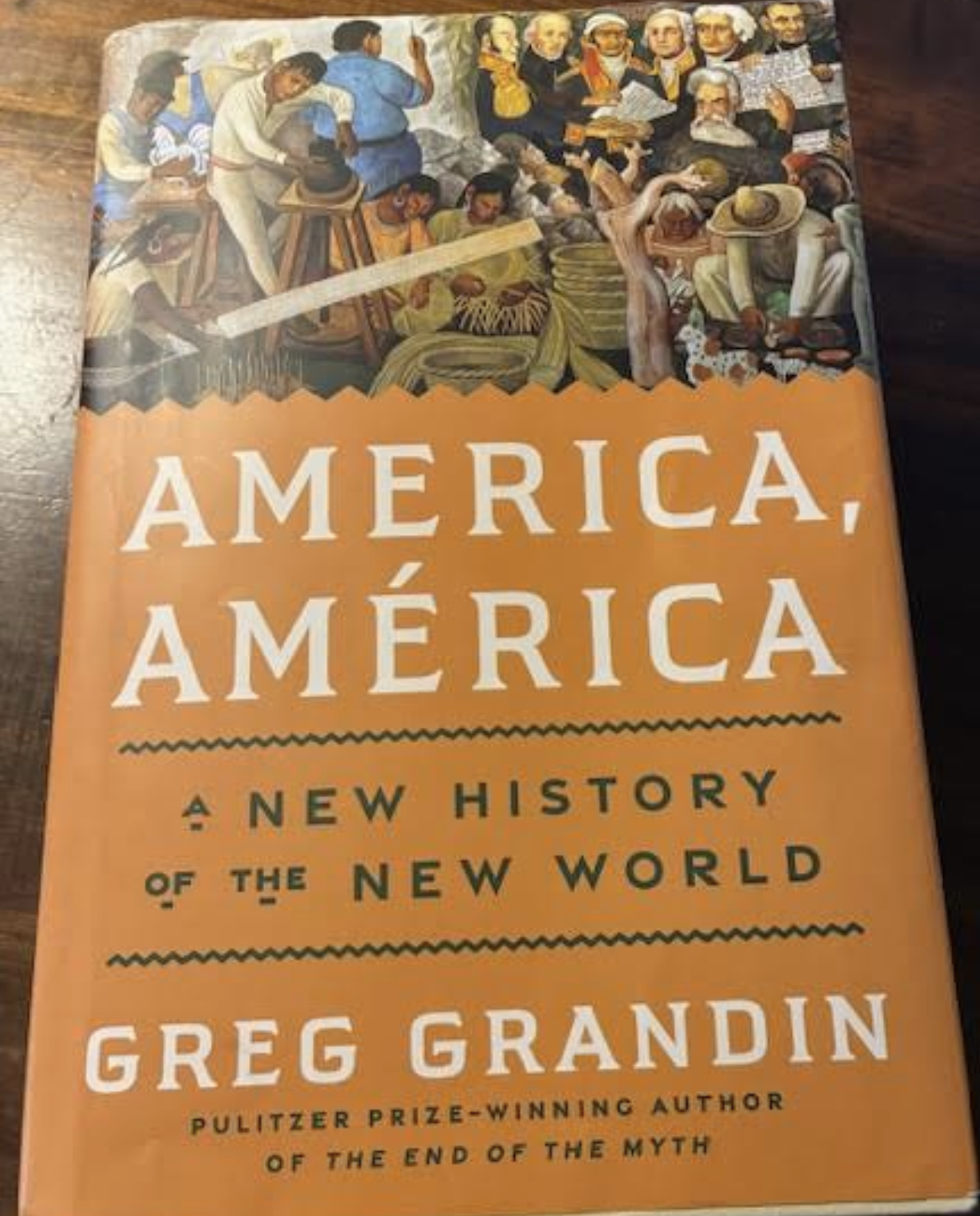
Recently I have been reading a truly seminal book, one correctly praised by historians as being “awesome,” “masterful,” and a “once-in-a-generation” history of the United States and Latin America. In a sweeping narrative Greg Grandin tells the story of the United States and Latin America from the Conquest to virtually the present. America, America: A New History of the New World (Penguin Press, 2025) at 630 pages is probably not for everyone, but well worth the effort for the intrepid reader.
Grandin’s work is a masterpiece of prodigious research told with erudition yet riveting in its prose. From the first pages to the last he faithfully carries the story of how the United States and the Hispanic states to the south were joined at the hip politically and philosophically. My fascination with Grandin’s work is that he provides bountiful evidence of what I have long believed and tried to convey to students: simply that we are all Americans in the Western Hemisphere, in North, Central and South America, regardless of cultural and indigenous differences. All of us here were formed by the crucible presented by the New World and that is what makes us all Americans.
What’s different about this work is that Grandin gives us a reinterpretation of our relationship and explains, sometimes redefining, the motives of Anglos and Latinos, challenging traditional histories. He shows how North and South differed but also worked together. Their clashes and cooperation led to the founding of accepted diplomatic principles and social conscience for the larger region, including the Good Neighbor Policy and founding of the United Nations. Significant laws and ideals about governing helped shape the political identities of both the United States and Latin America. The efforts and ideas of Simon Bolivar, Francisco de Miranda, Alexander Hamilton and Woodrow Wilson have endured to this day. Indeed, Grandin argues that Latin America’s devotion to social democracy can be an effective antidote to today’s swing toward right-wing authoritarianism.